
Free bill analysis - bring a power bill, get the production math for your actual roof, panel brands like Qcells and REC compared side by side
If the pitch starts at your door and ends with "sign tonight for the special," sleep on it. The sun will still be there tomorrow; so will we.

 Before
 After
After Before
 After
After Before
 After
AfterEnphase EV Charger Installation: The San Jose Owner’s Guide
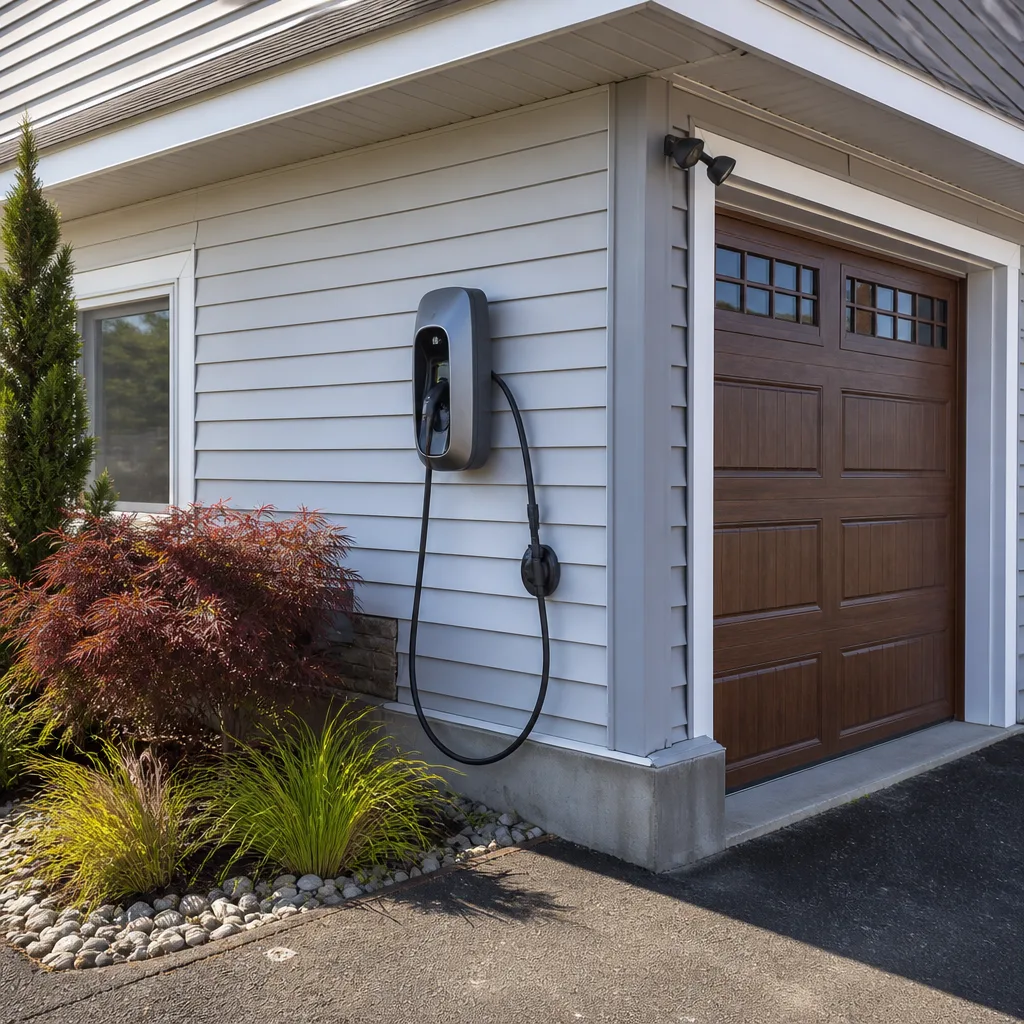
We install and replace Enphase EV chargers throughout San Jose, with most standard installations running between $650 and $1,900 depending on your panel’s available capacity and the distance from the panel to your parking spot. We keep Enphase chargers and the common failure parts on our trucks, and in most San Jose neighborhoods we can be on-site within 48 hours. The usual story we hear is this: the charger was working fine, then one morning the car didn’t charge overnight, or the unit throws a fault code, or the breaker trips every time the car pulls current. If any of that sounds familiar, this page covers what’s actually going on and what it costs to fix it properly.
Which Enphase Models This Applies To
Enphase makes three EV charger lines that we work with regularly in San Jose: the HCS-40 (a 32-amp unit they sold for years), the HCS-60 (48-amp hardwired model), and the newer IQ EV Charger line that ties directly into the Enphase IQ Combiner and IQ Gateway. The HCS models are straightforward 240V chargers that don’t require an Enphase solar system to operate, but the IQ EV models are designed to talk to your Enphase ecosystem and pull data through the Enphase app. Here’s a compatibility gotcha we see often: if you have an older Enphase system (M-series or S-series microinverters), the IQ EV charger’s solar-aware charging feature won’t work the way the brochure describes, because those older gateways don’t pass the consumption data the charger needs. The charger still charges your car fine, but you won’t get the smart solar integration. We always check your specific gateway model before recommending which charger to install. As for OEM vs aftermarket: Enphase doesn’t license third-party replacement internals, so for anything involving the control board or relay, OEM is the only reputable route. For external items like mounting brackets and conduit fittings, quality aftermarket parts from supply houses in San Jose work just as well and cost less.
Signs Your Enphase EV Charger Installation Is Failing
- Charger won’t start a session, or the car says “no power” from the charger. This is most often a welded or failed contactor relay inside the unit. It’s a known wear item on HCS-40 and HCS-60 models after five to eight years of daily use in San Jose’s temperature swings, and it’s a part we stock and replace.
- Breaker trips immediately or mid-charge. Usually a failing ground-fault detection circuit or a loose connection at the terminal block. Loose connections build heat, heat builds resistance, and resistance trips breakers. We see this a lot on installations done by non-electricians or in garages where the charger is near a water heater that corrodes connections over time.
- Unit shows a red fault light or a fault code on the small display. Enphase fault codes are specific, and we look them up per model before we load the truck, but the most common culprits are the internal GFCI module and the pilot signal board. If the light blinks in a pattern, write it down, that sequence tells us exactly what failed.
- Charging speed drops noticeably, or the app shows derating. The charger may be throttling because its internal temperature sensor is failing, or the thermal protection is kicking in early. In uninsulated San Jose garages that hit 100-plus degrees in summer, we replace more thermal sensors than anything else.
- Physical damage to the plug, cable, or holster assembly. Cables that get run over, chewed by pets, or yanked at an angle eventually fail where the cable meets the plug. This is a straightforward parts swap on most Enphase units, and we carry replacement cables for the HCS and IQ lines.
Replacement Cost & What’s Included
For a new Enphase EV charger install in San Jose, here’s what we quote, installed:
- Hardwired replacement (HCS-60 or IQ EV): $950 to $1,900 depending on panel work, conduit run length, and whether we need to add a dedicated breaker.
- Plug-in replacement (HCS-40 with NEMA 14-50 or 6-50 outlet already present): $650 to $950, assuming the outlet and wiring test good.
- Relay/contactor replacement on existing unit: $280 to $420, parts and labor.
- Thermal sensor or GFCI module replacement: $200 to $350, parts and labor.
- Cable or plug assembly replacement: $180 to $320 depending on length.
The wide range on new installs is honest: a garage directly below a 200-amp panel with space for a breaker is a one-hour job, while a detached garage 60 feet from the panel across a San Jose backyard is a different animal entirely. Every quote includes the permit where the city of San Jose requires one, the breaker, the wire, the disconnect if code calls for it, and our labor. The price we quote over the phone after you send us a few photos is the price on the invoice. Our 90-Day Done Right Promise applies to every EV charger job: if something isn’t right, Gus makes it right, in writing. The senior and veteran 10% discount applies here too, and there’s no trip charge inside San Jose and surrounding Santa Clara County.
DIY or Call Us?
Here’s the honest split. You can safely check a few things: confirm the breaker isn’t tripped, make sure the plug is fully seated in the outlet, and look at any fault light pattern on the unit. You should not open an Enphase charger and attempt a relay or board swap yourself. These units carry 240 volts at up to 48 amps, and the capacitors inside hold a charge even after the breaker is off. A wrong move can stop your heart. We’ve also repaired several chargers that owners tried to fix first, and the additional damage always costs more than the original repair would have. If you’re in San Jose and the charger is doing anything more than needing a breaker reset, call us at (877) 550-6892 and we’ll walk you through what we think it is over the phone, then send Gus’s crew out to make it right.
FAQs
We typically see 7 to 10 years of reliable service from Enphase chargers in San Jose, with the relay and thermal components being the first things to go on daily-use units. A charger used once or twice a week may last 12-plus years, while one running a full charge cycle every night in a hot garage tends to fail sooner. Call (877) 550-6892 and describe your usage pattern, and we’ll give you a realistic life expectancy for your specific model.
Yes, in roughly two-thirds of the failures we see in San Jose, the problem is a single component like a relay, sensor, or cable, and the repair runs $180 to $420. If the control board itself has failed or the unit has multiple issues, replacement usually makes more financial sense, and we’ll tell you that plainly before recommending anything.
Most Enphase EV charger replacements in San Jose take two to three hours from arrival to cleanup, assuming the existing wiring and breaker are in good shape. If we’re running new conduit or upgrading the breaker, plan on a half day. We’ll tell you the realistic window before we schedule.
We stock the common Enphase failure parts on our trucks, including relays, GFCI modules, thermal sensors, and replacement cables for HCS and IQ models. For a full charger replacement, we pull from our local San Jose supply houses, so most installs happen within a few days. We also work with Tesla, SolarEdge, and Qcells equipment, but Enphase is a brand we know inside and out.
Written by Gus Petrakis, Owner, Gus’s Solar at Gus’s Solar, serving San Jose and nearby areas.